
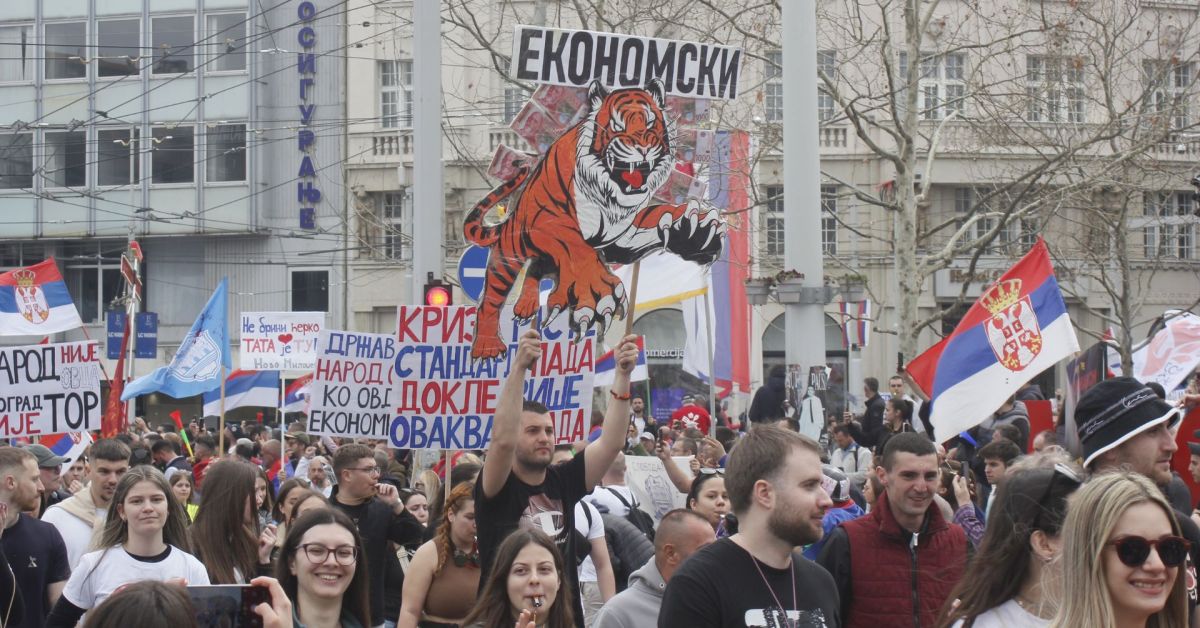
In the fourth month of student-led blockades of Universities in Serbia, a social media account dedicated to the protests, published a post that read: “We are fighting to build a system never seen before in the world. We have no one to look up to.”
In that very world, climate change is treated as an afterthought, while military arms race is once again normalized. The dominant political figures of our time seem more like reality show caricatures than leaders. They wish to stir up confusion and anger. They create their own truths. Serbia has not only joined this trend; it is where this absurdity dug its claws the deepest. A perverse ecosystem that manufactures a parallel universe in which the party and its leader are infallible and where only sycophant loyalty is rewarded. This ideological vacuum created a lack of self-confidence, established a nationwide lethargy and a cozy existence for political elites who thought their positions were secured until the end of times. Until they weren’t.
Thanks to the incredible diligence and almost spiritual intuition, students, organized without loud figureheads and without party booklets, demanded accountability. What began as a protest over a deadly infrastructure collapse in November 2024 has grown into the largest civic mobilization in country’s history. Unlike some other, also significant, earlier movements, this one is deliberately apolitical. Or rather, post-political. The students first rejected the existing Student Parliaments, by the fact of them being captured by the state. Soon after, they quickly refused alliances with opposition parties which enabled the massive scale up of the protests, since belief in party politics in Serbia is extremely low.
Furthermore, any of the students who rose to prominence (through eloquence or in some cases even physical appearance) and showed ambition to contest in the existing political arena were not given support by the decentralized student organization. Student’s modus operandi is through plenums, directly democratic assemblies where every voice holds equal weight. The current abomination of political system that, in their eyes, only produced transitional losers and gave rise to corruption seeping through every part of society is not something to aspire to. It’s something to remodel.
Even though the students call for the political actors to act within their constitutional limits, something deeper is brewing behind the clarity of the four demands. Transparency of documentation regarding the fallen canopy, legal responsibility for those involved, amnesty for arrested students during the first wave of para-state repression and increased funding for education, if met, can be framed within the current political system. In reality, however, that same system cannot meet those demands because it could spark a chain reaction of responsibility of the party higher ups. That’s why the demands are the rebuke of the entire system. Not just the ruling party, but the very architecture of representative politics, which has become a global symbol of polarization.
In this sense, the students are not only resisting, they are prototyping. Without referencing ideology, they are practicing a form of self-governance rooted in Serbia’s own history: the Yugoslav experiment of samoupravljanje (self-management). In socialist Yugoslavia, workers and communities were granted limited control over factories, schools, and institutions through directly elected councils. Though flawed and often constrained by party oversight, the idea was bold: people should govern the spaces they inhabit. Students participated in university councils; workers ran assemblies to make decisions about their workplaces. It was, for all its contradictions and eventual failure, an attempt to humanize socialism through decentralized, participatory democracy.
Today’s plenums echo this legacy, but not from a nostalgic standpoint. It’s a collective memory of the people living in this area, summoning a stored knowledge in times of need. With no leader to trust, no institution to lean on, students have turned to one another. They manage logistics, strategy, communication, and security through working groups. They debate and vote in open forums. They coordinate countrywide actions.
In only 4 months this call to action showed more promise than 10 years of impotent work of fragmented opposition. When opposition parties put forward their own demands, they were numerous and convoluted. Students are demanding four, morally clear demands. When the opposition nominated their candidates for government roles, they squabbled about insignificant matters. Students do not tolerate petty chiefs. When opposition leaders called the people to the streets, their speeches were uninspiring. Students sing in chorus or ask for cathartic silence. When opposition organized the demonstrations, the pinnacle of innovation was walking in circles in the city center. Students walked from city to city, not only street to street. They inspired the people locally; smaller towns like Šabac or Bogatić already formed their own assemblies. And this month they decided to go international, biking to Strasbourg to try to gather support from abroad.
During all these brilliant successes and incited emotions among the citizenry, the regime tried to pigeonhole the students in the same box as their previous opponents. To expose, co-opt or crush the leaders is their dream. But the smart youth don’t want to enter that kind of boxing ring. It’s dirty and slippery, the opponent wear plaster gloves and the referees are bribed. Students are playing their own game.
In refusing to be absorbed into the geopolitical East-West binary, in rejecting political parties, and in building something real from the ground up, Serbian students may be pointing toward a new form of politics altogether, one based on practice. In a world that seems on the brink of conflict, they are reminding us of something we have forgotten: people can make decisions for themselves. Democracy should not be a hollow word used only to discipline impoverished. It is not a brand. Democracy is exercise. It should be a habit. And something that we can improve upon by dreaming of better and fairer world.
And in Serbia, for the first time in decades, someone finally woke up.

